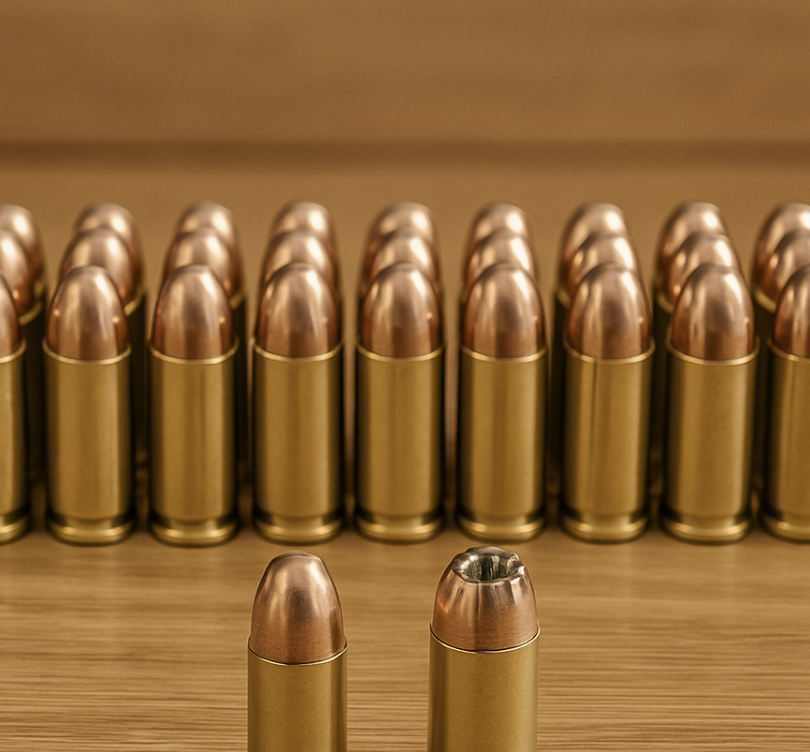
Choosing the right ammunition begins with understanding how different bullet designs function. Two of the most common types—Full Metal Jacket (FMJ) and Hollow Point (HP)—serve very different purposes, even though they may look similar at a glance. Knowing how each one is built, how it behaves upon impact, and where it performs best helps you make informed decisions whether you’re practicing, training, or preparing for personal protection.
Full Metal Jacket ammunition is the most familiar kind of cartridge for many shooters. An FMJ bullet features a soft lead core encased in a harder metal shell, usually copper. This jacket keeps the bullet from deforming as it travels through the barrel, which helps maintain consistent flight characteristics. FMJ rounds are known for reliability, smooth feeding, and affordability. Because they are mass-produced and designed for general use, they’re ideal for range training, recreational shooting, and learning the fundamentals.
One of the key characteristics of FMJ ammunition is penetration. FMJ bullets tend to pass straight through a target, maintaining their shape throughout the process. While this is useful for predictable performance on paper or steel targets, it can pose challenges in defensive situations. Overpenetration—the bullet continuing well beyond its intended target—can create safety risks in a home or public environment. This is one reason FMJ is rarely recommended for personal protection.
Hollow Point ammunition is engineered with a different purpose in mind. The defining feature of an HP bullet is its hollowed-out tip. This design allows the bullet to expand upon impact, creating a wider wound channel while also slowing the bullet down inside the target. This controlled expansion helps reduce overpenetration, because the bullet sheds energy more quickly. As a result, HP rounds are widely used for self-defense and law enforcement applications.
Because of this expansion, hollow points generally offer better “stopping power,” a term many shooters use to describe how effectively a bullet transfers energy into a target. When the bullet expands, it becomes less likely to exit with significant velocity, which can make it safer in enclosed environments. This quality can be particularly important in situations where loved ones or bystanders must be considered.
Accuracy is another area where differences appear. FMJ rounds are often extremely consistent and provide excellent results at the range. They are made to be uniform and economical, which supports repeatable practice. Hollow points can be just as accurate, but they are typically optimized for terminal performance rather than cost efficiency. Because defensive ammo tends to be more expensive, shooters sometimes train with FMJ and verify reliability with a smaller amount of HP.
Cost is a practical consideration for many gun owners. FMJ ammunition is typically far more affordable, making it the preferred option for regular range sessions. Hollow point ammunition, with its more complex construction and specialized purpose, costs more per round. This difference is one reason many shooters maintain two separate supplies: FMJ for training and HP for defense.
Another point to consider is firearm compatibility. While modern firearms generally feed both types well, some older models or certain compact designs may have difficulty cycling hollow point rounds consistently. This makes reliability testing essential. Running a few boxes of your chosen HP through your firearm ensures that it feeds smoothly, cycles reliably, and performs correctly.
Selecting between FMJ and HP ultimately comes down to purpose. For high-volume training, skill development, and recreational shooting, FMJ remains the most practical and economical choice. For home protection or concealed carry, hollow point ammunition offers performance characteristics better suited to personal safety.
Understanding the difference between these two bullet types equips you to build a well-rounded ammunition strategy—one that keeps training affordable while ensuring you have dependable rounds for defense when it matters most.
Leave a Comment